| Newsletter Summer 2006 | page 2 of 4 | |
 |
|
|

Cahir Heritage Food Fair
A Heritage Food Fair will take place in Cahir on
Saturday 2nd and Sunday 3rd of September. It is being organised by the
members of Cahir Farmers' Market and many others from various
organisations and businesses in Cahir.
The purpose of the event is to promote Cahir locally and nationally, as
a 'Food and Heritage' destination.
Cahir is a heritage town situated in a great food producing area. Many
of the old buildings in Cahir town are directly connected with the foods
of the region. The Cahir Mills with their big water wheels and massive
old diesel engines, the Granary in Church Street, Cahir Bakeries and so
on. The commerce of Cahir has been and continues to be deeply connected
with food production. Every year the farms in the Cahir area produce
millions of gallons of milk, thousands of prime beef cattle and sheep,
and thousands of tons of wheat, oats and barley, along with a large
variety of other produce. The town and the farms of the area are proud
of the food that is produced in the region, and are glad to show it off
in the Heritage Food Fair which is being run at the end of Heritage Week
on September 2nd and 3rd.
Our cherries
During the middle of July we harvested our first ever
crop of sweet cherries. We started with a variety called Regina, which
was followed by Sam and Schneiders, and lastly we had Kordia. Because it
was our first ever harvest, and because we only have 180 trees, we
probably harvested no more than 100 punnets. But I know that those of
you who had them certainly enjoyed them, and next year we hope to have
some for everyone.
Now as you know, the summer of 2006 was very good, and indeed, not only
did the 180 cherry trees in our tunnel produce fruits, but so too did
the five trees in my garden. Those trees were initially planted in 1996,
and this was their first proper crop, even though every year they have
given a wonderful show of white flowers for a week in springtime. If you
would like to plant a fruiting cherry or two in your garden, you, like
me, may have to wait quite a few years for a crop. But what a bonus when
you get a crop, as the flowers of sweet cherry are just as nice as any
other garden ornamental, and most of those will never give fruits.
If you would like a large tree, to twenty feet tall or more, get a tree
on Mazzard rootstock. If you would like a medium tree, of perhaps ten
feet, then a good rootstock is Colt. And if you prefer a small tree,
like the ones in my tunnel, then you should ask for a tree on Giesla 5.
A new tractor
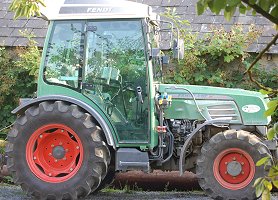 It's not very often that we get a new tractor at
the apple farm. Among those in service on the farm at the moment are a
20 horsepower Renault from the 1960's, a Massey Ferguson 135 from 1967,
and two "newer" tractors from 1980 and 1982. However, this
year, we are getting a new orchard tractor, so called because it is
designed to be narrow enough to fit down the rows in the orchard, and
the type we are getting is a Fendt. Fendt tractors are made in Germany
by the same parent company that makes Massey Ferguson, but Fendts are
especially well known for their fuel efficiency.
It's not very often that we get a new tractor at
the apple farm. Among those in service on the farm at the moment are a
20 horsepower Renault from the 1960's, a Massey Ferguson 135 from 1967,
and two "newer" tractors from 1980 and 1982. However, this
year, we are getting a new orchard tractor, so called because it is
designed to be narrow enough to fit down the rows in the orchard, and
the type we are getting is a Fendt. Fendt tractors are made in Germany
by the same parent company that makes Massey Ferguson, but Fendts are
especially well known for their fuel efficiency.
Having spoken with a number of conventional farmers, I am confident that
this new tractor will accomplish the same amount of work using 30% less
fuel than any other equivalent tractor. One agricultural contractor told
me how, by switching from a different make of tractor to Fendt, for his
three tractor fleet (of very large tractors), he was saving 500 euros
worth of diesel per week.
Now while the tractor I will get will be much smaller, and will not be
used so often, I am still looking forward to the best fuel-efficiency
that I can get in the orchard.
Now if only I could start distilling biofuels from my apple juice
by-products.
In our farm shop
We look forward to a wonderful crop of apples,
commencing around August 20th. And by the time you receive this
newsletter, we will have some plums, soon to be followed by raspberries
and second crop strawberries. We also have fresh strawberry jam, plum
jam, and of course apple jelly. We also plan to make more apple &
raspberry juice with the delicious raspberries we have frozen in the
past few weeks, though that won't be ready until sometime in October.
Our apple juice is in stock in all sizes of bottles and bag-in box, and
as always, the playground is open for all who wish to partake.
New cold stores
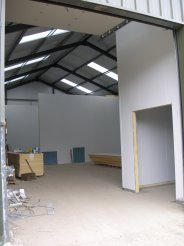 At the moment we are also constructing some new
cold stores on our farm, so that we will have somewhere to hold the
extra apples we hope to harvest from our newly planted orchards. Keeping
apples cool, at about 2ºC, is the simplest way to keep them fresh. And
thanks to the abilities of modern computers, new highly efficient
cooling systems are now available. So, for our three stores, we can use
a single cooling pack. It would be like having three fridges side by
side in your house, but only one refrigerator unit running all three,
being monitored by computer, and switching over and back between the
fridges, and thus saving energy, especially when the fruit are cooled,
and not needing much extra cooling input.
At the moment we are also constructing some new
cold stores on our farm, so that we will have somewhere to hold the
extra apples we hope to harvest from our newly planted orchards. Keeping
apples cool, at about 2ºC, is the simplest way to keep them fresh. And
thanks to the abilities of modern computers, new highly efficient
cooling systems are now available. So, for our three stores, we can use
a single cooling pack. It would be like having three fridges side by
side in your house, but only one refrigerator unit running all three,
being monitored by computer, and switching over and back between the
fridges, and thus saving energy, especially when the fruit are cooled,
and not needing much extra cooling input.
This is all helped by the fact that the stores are being built using 6
inches (15 cm) of insulation in the walls and ceiling, and 4 inches
(10cm) in the floors. Once the contents (in our case apples) in a fridge
that is this well insulated become cool, even with the fridge turned
off, it would take quite a few days for them to even begin to warm up,
though it is not something we are planning to try.
So, if you call for apples this winter, as well as being aware of their
exceptional freshness, you can rest assured that they have been stored
in the simplest and most efficient way possible.
More about apples and your health:
Cornell Study Finds Apples May Reduce Breast Cancer Risk Cornell University has conducted the first-ever study on the direct effects of apples on breast cancer prevention in animals. In this study, led by Dr. Rui Hai Lui, Cornell Associate Professor of Food Science, the more apples consumed, the greater reduction in the incidence and number of breast cancer tumors. Research found that the phytochemicals present in apples may contribute to their anti-cancer activities. This study is published in the March 2005 edition of the Journal of Agricultural and Food Chemistry.
- Page 1: June Drop
- Page 3: Recipe: Raspberry Cake
- Page 4: Soccer, by Willem Traas
- Newsletter main page